| |
 Frequently Asked Questions Frequently Asked Questions
Is hematuria really hematuria?
A perplexing urologic problem that I frequently hear Primary Care Physicians ask about is microscopic hematuria. I have decided to devote a PCP Update to this topic acknowledging that the vast majority of the following information was taken right from the American Urologic Association Guidelines for the diagnosis, evaluation, and follow-up of asymptomatic microscopic hematuria in adults.
A separate article will discuss gross (visible) hematuria which does require urologic evaluation unless secondary to a documented urinary tract infection by culture.
The definition of asymptomatic microscopic hematuria is defined as three or more red blood cells (RBC) per high-powered field on a properly collected urine specimen. A negative repeat microscopic urinalysis following a positive test does not preclude the need for evaluation as outlined below. A positive dipstick urinalysis does not define asymptomatic microscopic hematuria (AMH).
Please click here to read more.
Is the test or procedure my urologist recommended necessary?
Dr. Goldberg, a Dallas / Fort Worth Urologist, recently have become aware of an organization with a campaign called "Choosing Wisely" whose goal is to improve quality and reduce waste by getting physicians and patients talking about medical tests and procedures which may be unnecessary and possibly harmful.
So far, more than 60 national medical societies have joined the initiative www.choosingwisely.org to identify and create lists of the top five tests and procedures that they say are over-used or inappropriate.
Please click here to read more.
What is Peyronie's Disease and what are the current treatment options?
Peyronie's Disease is a local connective tissue disorder characterized by a change (scar formation) in the collagen composition of the tunica albuginea of the penis.
The two corpora cavernosa and corpus spongiosum of the penis are composed of an elastic covering within the tunica on top of the erectile-spongy tissue inside. During an erection, blood is trapped in all three corporal bodies leading to dissension of the corpora and an erection occurs. Peyronie's plaque, which is composed predominately of collagen, although calcium deposits may occur, replaces the normal elastic tissue. This results in penile deformity, primarily a curvature (I have seen up to 120 degree bends!); along with penile narrowing, indentation and shortening of the penis.
Please click here to learn about current and alternative treatment options for Peyronie's Disease.
Is it true that testosterone replacement therapy is associated with an increased incidence of cardiovascular issues or deaths?
I have received numerous calls and questions from men on testosterone therapy
who have seen advertisements by attorneys regarding lawsuits related to deaths, heart attacks, and
strokes from testosterone replacement therapy.
Click here to read a revision of the Texas Urology response originally distributed on
November 10, 2013, discussing the article in JAMA
(JAMA.2013;310(17):1829-1836.doi:10.1001/jama.2013.280386) that set off all the controversy.
What does Post-Traumatic Stress (PTS) have to do with Urology?
Essentially, very little. What does PTS have to do with me? A lot.
My younger son, Josh, went to work for an organization called "Save a
Warrior" (www.SaveAWarrior.org), as their Head of Awareness and
Contributions. (NOTE: This article is not intended in any manner, shape or
form to request any donations from you) Save a Warrior works with returning
veterans (called Warriors) who have significant PTS, are highly suicidal, and
have exhausted all other means of resolution of their problems. Josh and the
creator/executive director invited me to embed as a civilian (called a
"witness") for a cohort of 12 Warriors with significant PTS recently at the 5½
day program in southern California. Ten of the 12 men have admitted to
having had a gun in their mouth in the last month, and one admitted on
camera to CNN's Soledad O'Brien, who filmed the entire week for a special
to air this summer, that if this program didn't work, he was going to kill himself.
Click here to read the complete article by Dr. Kenneth Goldberg.
Is it safe to use testosterone while being treated for prostate cancer?
Doctors, trained between 1960 and 1995, were of the opinion that using testosterone in men with prostate cancer was like "adding gasoline to a fire". This was the admonition and categorical contraindication to the use of androgens in men with prostate cancer because androgen replacement therapy was thought to hasten the recurrence of the disease. There were even physicians who were fearful of using androgens in clinically hypogonadal men because they were concerned about increasing the risk of prostate cancer by using exogenous androgens. Using evidenced based medicine, it is now considered safe to use testosterone in some men who are symptomatic for hypoandrogenism, who have documented decrease in their serum testosterone level, and who have been treated for localized prostate cancer.
It has also been proven that supplemental androgens in men without prostate cancer is safe and does not lead to prostate cancer. HOWEVER, IT SHOULD BE NOTED, ACCORDING TO THE FDA, THE USE OF TESTOSTERONE THERAPY IN MEN WITH A HISTORY OF PROSTATE CANCER IS CONTRAINDICATED.
Click here to read the full article.
New erectile dysfunction drug Stendra: Is It Faster? Is It Better?
Recently, a new PDE5 inhibitor, Stendra, (Avanafil) was approved by the FDA and you will be
hearing about it very shortly. Based on the information that I have, in the majority of ways, it is
simply a ME-TOO drug.
The main difference relates to onset of action. Stendra's
main claim to fame will be onset of action as early as 15
minutes. Its T max, however, is 30 to 45 minutes in the
fasting state. Although the package insert states it can
be taken with or without food, a high fat meal reduces
the rate of absorption and delays the T max to an hour
and fifteen minutes. Duration of Stendra is the same as
Viagra and Levitra at 4-6 hours. Viagra and Levitra
report onset at 30 minutes to 1 hour. Cialis is about the
same or a little longer, but duration is 24-36 hours.
Click here to read the full article.
Omega-3, What is the True Story?
Recently, a study was published in the Journal of the National Cancer Institute suggesting a link between omega-3 fish oil and an increased risk of prostate cancer. Texas Urology has fielded numerous questions as a result of this media coverage and many questions have been answered regarding whether men should discontinue the use of omega-3 supplements. This reminds me of a time in the mid 1990's when an article appeared implicating vasectomies in an epidemiologic study linking this common procedure to prostate cancer. Previously, there had been isolated studies suggesting that vasectomy could cause testicular cancer and atherosclerosis. Needless to say, further studies as well as review of prior studies showed these results to be false and, indeed, vasectomy is not associated with prostate cancer, testicular cancer or atherosclerotic heart disease.
Click here to read the full article.
Is it safe to receive treatment for low testosterone?
Many men as they age, face symptoms of low testosterone (low T), such as low energy and low sex drive. There has been a lot of discussion and research on menopause in women, however, not until recently has there been a spotlight on low testosterone (low T) in men. Some have called this “Andropause”. Low testosterone affects about 40% of men over the age of 45. As men age, their levels of testosterone may decrease. Increasingly people are mentally, physically and sexually active much later in life than their parents or grandparents were. This awareness of low testosterone is only magnified by the numerous “Low T Centers” that are popping up in advertising in newspapers, radio and TV.
Click here to read the Texas Urology Opinion on the recent JAMA study linking Testosterone and Heart Disease.
How can kidney stones be prevented?
Stones are seasonal. Stones increase with warm
weather in addition to being more prevalent in warmer
parts of the country. With the warm weather coming,
you can expect to see an increase in the number of
your patients complaining with renal colic. While there
is no good explanation for this fact, one theory is
dehydration, which leads to dislodging of the stones
from the lining of the uroepithelium.
Click here to read the full article.
How is Alpha-Blocker Therapy used in the Management
of Urological Disorders?
Activation of Alpha adrenergic receptors for smooth
muscles causes the smooth muscle to contract. Alpha
blockers, therefore, produce smooth muscle relaxation
by inhibiting contraction of this type of muscle. There
are multiple types of alpha receptors resulting in
different levels of selectivity of the alpha blockers.
Alpha blockers have
been shown to improve urinary symptoms by virtue of relaxation of
the smooth muscle of the prostate and the bladder neck. This results in an increase in urinary
flow, decrease in urinary dribbling, decrease in residual volume, and can improve urinary
frequency and urgency.
Click here to read more.
What are treatment options for Overactive Bladder (OAB)?
OAB (over-active bladder) is found in both men and
women and is associated with the symptoms of
urgency, frequency, nocturia and urge incontinence.
Click here to read about two approaches to the symptoms of urge incontinence.
What can I do to prevent myself from developing prostate problems,
such as enlargement and prostate cancer?
 Your concern is well founded.
Approximately a third of all men over 50 suffer from prostate enlargement,
and prostate cancer is now the most common malignancy in America. Fortunately,
there are important steps you can take to reduce your risk of developing
prostate problems.
Perhaps most important, reduce the amount
of dietary saturated fat (red meat, and full-fat dairy products) that
you eat. It's no coincidence that American men eat more saturated fat
and have higher rates of prostate cancer than men from any other nation
or that foreign men who move here and adopt our diet soon have a higher
incidence of prostate cancer. In fact, research at Sloan Kettering
has shown that increased fat in the diet of rats not only increases
the risk of prostate cancer, it also affects the rate at which the
cancer grows.
Drink at least eight glasses of water
per day. A thorough flushing helps keep your prostate, and your entire
urinary tract, happy.
Be sure to get adequate zinc in your
diet. Good sources include oysters and other seafood, whole grains,
nuts and beans. Be careful with zinc supplements, though. More is not
necessarily better. 
Men who have borderline prostate problems
usually find hot baths comforting, and avoiding caffeine, alcohol,
and spicy foods is worthwhile. Evidence also continues to accumulate
that saw palmetto is helpful to the prostate without causing significant
side effects.
Discovering prostate cancer early, when
it can be treated successfully, is second best to avoiding it in the
first place. Be sure you have an annual digital rectal exam beginning
at 40 and a yearly PSA blood test beginning at 50 (earlier if you have
a family history of prostate cancer).
Finally, although I know this
one will be tough to face, try to ejaculate regularly. Because the
prostate provides some of the fluid in semen, ejaculation may help
keep it well drained. You can consider that a prescription.
[Top]
How
can a man relax and let things happen naturally?
It
is a widely accepted fact that for a man to have sexual desire, to
be able to be aroused to erection and orgasm, he must feel relaxed.
Our emotions about a given situation are determined by what we think
about that situation. This is called the ABC's of thinking and feeling:
A.
The situation.
B. The thought or label about the situation.
C. The emotional outcome that results from how one labels the situation.
For
example, if the situation
A.
is that a man is going to have sex, the thought
B. is that he is worried about being able to function, then the resulting
feeling
C.
is that he is anxious.
As
a man moves from pleasure and relaxation to performance and anxiety,
the chances of problems increase. In other words, the concerns or
fears of being able to perform are sufficient to produce anxiety
and result in a lack of ability to attain or maintain an erection.
All men have a psychological reaction to an erection problem even if
its cause is primarily physical.
What
do women think when a man can't get hard? 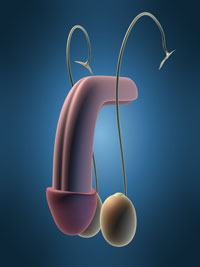
When
a man has an erectile problem, the couple has a sexual problem.
The women in the relationships frequently have questions, doubts, resentments,
insecurities, and a need for information, understanding, and reassurance.
Too often the man alone is seen as the patient and his partner is -
at best - barely acknowledged, and - at worst- merely tolerated or
even discouraged.
It is not enough if the partner's participation is limited only to
hearing the patient's interpretations of the doctor's replies. Filtering
information and questions through the patient to the woman can lead
to misunderstanding and unhappiness. The woman's own concerns and questions
must be addressed. Unlike many areas of medicine where only the patient
is treated, with erection problems both members of the couple need
to be considered.
Sometimes a woman, raised on the myths of men as highly sexual and
always ready, sees her partner's erection as an emotional lie detector.
A woman may view an erection as proof that a man loves or desires her.
Therefore, she believes the absence of an erection means he doesn't
care, or doesn't find her attractive.
A potency problem can spiral into a major communication breakdown in
a short period of time. A typical scenario goes like this: a man experiences
erection difficulties, feeling ashamed, embarrassed, and "less
of a man," he withdraws from his partner. With the lack of ability
to perform, it's not uncommon for men to have a marked drop in their
desire or libido. After all, why put yourself in a position where you
may not be able to perform? Over time, he may go so far as to refuse
to kiss her, hug her, even to hold hands with her, saying, as did one
man, " I didn't want to start anything I couldn't finish." He
may start arguments to avoid sexual encounters. Because he doesn't
understand that he has a health problem, not a character defect, he
may refuse to discuss the issue with anyone including his partner,
his doctor, a friend. Meanwhile, the partner is feeling rejected, neglected
, and full of self-doubt. She may question her own attractiveness.
She may wonder if her husband still cares for her. She may even think
he is having an affair. She may withdraw. She is often afraid to bring
up the subject that is so obviously painful for her husband. The result:
each partner is isolated and miserable. Unfortunately, relationships end over this situation.
A number of women whose partners have potency difficulties feel inadequate.
It's not uncommon for a woman to blame herself. A woman may be fairly
open about her self-blame or she may keep her feelings quite hidden.
A woman may also feel hurt and angry because her partner has withdrawn
from her physically and emotionally. The relief felt by an insecure
partner who understands she is not to blame can be enormous and can
enable her to more fully participate and support her partner's diagnosis
and treatment.
What
causes an erection?
During
an erection blood fills two chambers in the penis and is trapped there.
The erection begins when the arteries open up as the smooth muscles
of the vessel walls relax.
The veins which drain the blood then close down and prevent blood from
leaking out. A man must have an adequate blood pressure to carry blood
into the penis, and can have no leaks in the veins of his penis that
will allow the blood to escape.
The nerves are the control mechanism which coordinate the increase
in pressure in the penis as well as the closing down of the veins.
A man needs sufficient levels of testosterone in order to have the
desire, feel aroused, and to get an erection.
Any physical or emotional factor that affects a man's arteries, veins,
nerves, or hormones can impact his erections. A man must allow himself
to relax in order for the blood vessels of the penis to also relax
so that he can get and maintain an erection.
A discussion of the problem followed by a physical examination is the
first step toward diagnosing the cause of the problem.
How
does stress relate to impotence?
Stress
is defined as any mental or physical demand that is placed on a person.
Stress comes from "good" things as well as events labeled
as "bad." Adrenaline is an erection buster. Adrenaline is
fine when we're cheering for our favorite team or in the middle of
a heated argument... certainly not when we'd want to get an erection.
A person's reaction to stressful events is physiological. Stress can
cause a man's heart rate to increase, and it can elevate blood pressure,
increase muscle tension, and speed breathing. This phenomenon is called
the "fight or flight" response.
What some people don't know is that stress can pile on and cause a
cumulative effect. Constant arousal due to stress, can affect sleep,
energy level, and concentration, as well as sexual desire and functioning.
Most patients and their partners are not surprised that stress can
cause an ulcer or a rise in blood pressure. They are often surprised,
however, that these factors can have an effect on erections. A man's
normal response to stress, such as being afraid or angry, is for the
nervous system to move blood away from "nonessential" activities
and into muscles so that he can either fight or get away from the situation.
Ironically, fear of not being able to achieve an erection can actually
cause an impotence problem. That's because if a man thinks that he
is not going to get a erection, his body may respond to this belief
by shunting blood away from his penis, thus making his erection go
away.
Are there any medical conditions that may affect sexual intimacy?
There
are a number of medical conditions that are associated with impotence.
Probably the most common is the use of certain medications that have
side effects that can affect a man's potency. Examples are drugs used
to treat high blood pressure, sedatives, tranquilizers, and pain pills.
Fortunately, the side effect of impotence is reversible when the dosage
is altered, or a different medication is prescribed by the physician.
Medical illnesses that are often associated with impotence are diabetes,
heart conditions and kidney and liver diseases. There are various surgical
procedures that are often associated with impotence. The most common
are cancer surgery of the colon, rectum, bladder, and prostate gland.
Most problems of intimacy in the elderly can successfully be treated.
If a woman is suffering from the problem of estrogen deficiency, then
she should consult with her gynecologist who might prescribe some form
of estrogen replacement therapy. If a man suffers from impotence, he
should contact a urologist who has sophisticated diagnostic techniques
to identify the cause of the problem and recommend appropriate treatment.
I
know there's an injectable medication that produces erections,
but I can't face the needle. Is there an alternative?
Although
many men are quite pleased with injections, you're not alone in your
dislike of needles. In the long run, self-injection is well accepted
by only about half of my patients. A number of devices have been developed
to hide the needle—including a pen-like apparatus about the size
of a cucumber that extends the needle with a push of a button—but
the needle-prick sensation is still there. Fortunately, a couple of
new approaches to inducing erections have arrived recently or soon
will.
Another form of delivery of the medication used for injections (Prostaglandin) is available through a small little rice-sized pellet that is inserted into the opening of the penis (MUSE). With this approach, the dose is slipped into the urethra using small plunger-like device. There it is absorbed through the urethra and into the penis.
While all my experience is not as successful as injections, the erection can last up to an hour and side effects are minimal, generally at the most a mild burning sensation for 10 or 15 minutes after insertion.
Three oral drugs are available (Viagra, Cialis, Levitra). These drugs work by prolonging the relaxation event of an erection. While all three drugs have a similar mechanism of action, there are some differences.
Viagra, the first drug out, must be taken on an empty stomach and its effects last for approximately four to six hours. Viagra and Levitra must be taken on an empty stomach, and the effects last for four to six hours. Cialis can be taken at any time and its effect can last for 24-36 hours. Side effects with the medication include light headedness, facial flushing, nasal congestion, and indigestion. Additionally, with Cialis, there is an incidence of back pain. Cialis is also available in a low dose tablet that is taken daily. This allows sexual intercourse at any time that the moment is right.
A little farther out on the horizon, an oral medication absorbed under
the tongue is now undergoing early trials to determine an effective
dose with minimal side effects. It may be a number of years before
it becomes widely available, but you should ask your doctor to keep
you up to date on progress.
You might also consider trying a vacuum device, which produces an erection
through suction developed by a pump. Most men can achieve an erection
using one, although many also tire of bothering with the apparatus
every time they want to have sex. It works, but it's not for the singles
set.
[Top]
Am I at risk for an enlarged prostate?
Prostatic enlargement is very common, and 50% of men over the age of 50 will experience enlargement in their lifetime. If you are experiencing some or all of these symptoms, it is important to consult a urologist. There are a number of tests that can be performed to evaluate the enlarged prostate as well as the effect on the kidney and bladder.
These tests can usually be performed in the office or outpatient setting. It is important to stress that all men over the age of 40 should have a rectal examination once a year to screen for prostate cancer.
The blood test called PSA is recommended for all men over the age of 50 with at least a life expectancy of 10 years, and all men over the age of 40 who are at high risk, including African-American men and those who have a family history of prostate cancer. The PSA can be elevated with enlargement, infection, or cancer.
Quiz
Here are some good questions to ask yourself, or if you are a woman checking this out for your partner, quiz him with these questions. Rate each question with the following points: Not at all=0, Less than 1 time in 5=1, Less than half the time=2, about half the time=3, more than half the time=4, almost always=5.
- Over the past month, how often have you had a sensation of not emptying out your bladder completely after you finished urinating?
- Over the past month, how often have you had to urinate again less than two hours after you finished urinating?
- Over the past month, how often have you found you stopped and started again several times when you urinated?
- Over the past month, how often have you found it difficult to postpone urination?
- Over the past month, how often have you had a weak urinary stream?
- Over the past month, how often have you had to push or strain to begin urination?
- Over the past month, how many times did you most typically get up to urinate from the time you went to bed at night until the time you got up in the morning?
If the score is under 8, prostate disease is mild and no real treatment is needed; a score of 8 to 17 indicates moderate disease and treatment can be done; a score over 18 is severe disease and treatment is most frequently surgery.
[Top]
There's
a lot of hype about how risky it is to have unprotected sex. What are
the real odds of catching a disease?
The
real answer to your question is that it depends on which disease is
being transmitted and who it's being transmitted to. The odds are as
high as 50 percent in some cases. For example, if a woman has unprotected
sex with a man who has gonorrhea, she has a 50 percent risk of becoming
infected. In the opposite case, the risk is 30 percent. In fact, in
nearly all cases, women are more likely to become infected by carrying
males than men are to be infected by carrying females. The risk for
younger women and, perhaps, for women who use birth control pills, may
be even higher. To worsen the situation, some diseases, such as chlamydia,
may not produce symptoms in a man, even though he can pass the disease
to his partner.
The
statistics look like this:
Risk
of Infection (%) from One Unprotected Encounter
| |
MEN |
WOMEN |
| Genital
Herpes |
30% |
30% |
| Gonorrhea |
25% |
50% |
| Chlamydia |
20% |
40% |
| Syphilis |
20% |
30% |
| Chancroid |
15% |
30% |
| Genital
Warts |
10% |
10% |
| Hepatitis
B |
5% |
10% |
| HIV |
.9% |
1% |
You
could look at these numbers and figure guys get off lucky. What
I see, however, is responsibility. If you fool around and get infected,
the odds of you infecting your spouse are very high, with potentially
devastating effects. Either of you could become sterile, and your
partner may suffer from chronic severe pain or develop cervical
cancer. The days are over when sexually transmitted diseases were
minor health problems that could be cured with a dose of antibiotics.
Only two of the eight on this list respond readily to medication,
and even those are developing resistance. Today, the old saying
that a one-night stand can last a lifetime has more than one meaning.
Monogamy
is the best form of disease protection, but if you wander, cover
up.
How
do I prevent sexually transmitted diseases? 
- Limit
your number of sexual partners.
- Avoid
sex with people you don't know well or people who have multiple partners.
- Always
use condom and spermacide, regardless of the need for contraception.
- Avoid
sex with people who are being treated for a sexual disease.
- Avoid
sexual contact with anyone who has visible lesions on the genitalia.
- If
you are infected with an STD, refrain from sexual activity until treatment
has completed.
Is
there anything new in treatments for that frustrating sexually transmitted
disease, herpes?
Unfortunately,
herpes' main calling card—that it's controllable, not treatable—hasn't
changed. Once you get it, the painful bumps and flu-like symptoms may
recur four to eight times per year for years. (Bear in mind that herpes
can be transmitted even when a person has no symptoms.) For most people,
the frequency and severity of outbreaks decline over the years, but
especially in the early years, medication may be helpful.
Acyclovir (brand name Zovirax) has been around for several years. For
people with frequent and severe recurrences, it can be taken regularly,
which may reduce the likelihood of a recurrence. More often, it is taken
at the onset of symptoms, which reduces their severity.
The disadvantage of acyclovir is that it may need to be taken 5 times
per day for 5 to 10 days to reduce symptoms and 1 to 4 times per day
to suppress recurrences. The price tag can amount to about $5 per day.
Two newer medications on the market include famciclovir (Famvir) and
valacyclovir (Valtrex). Both are effective in combating the symptoms
of recurrence. Additionally, recent studies have come out showing that
one can reduce the outbreak and even transmission without an outbreak
by daily dosing in a prophylactic, or preventative, fashion.
At least four other antiviral therapies are in clinical trials now.
You can find out more about them on the Internet at Center
Watch - Clinical Trials Listing Service. For the foreseeable
future, though, the best herpes therapy is to avoid it in the first
place.
[Top]
How can I prevent testicular cancer?
All men should perform monthly self-testicular examinations just as women do monthly self-breast examinations. The optimal time to perform the examination is while taking a warm shower. Both hands should be used to examine each testicle with the thumbs in front and the first two fingers behind the testicle. The testicle should be rolled between the fingers and thumb, feeling for any lumps or bumps.
The testicle normally feels like a hard-boiled egg without the shell. If lumps or bumps are discovered, a physician, preferably a urologist, should be consulted at once. The best chance of prevention is early detection and treatment.
I have persistent discomfort in my testes during the day, particularly after sitting. Should I be concerned about cancer?
You're wise to be concerned about testicular cancer; it's all too common in young men and returns as a risk after your 40s. I suggest that you see a doctor to rule out that possibility, but as long as you've been doing monthly self-exams, and no lumps or hard spots have developed, that probably isn't your problem.
A variety of difficulties can lead to pain in one or both testes. When you're examined by your doctor for cancer, he can also check for hernia, which can cause the symptoms you describe.
If you feel pain mainly when you ejaculate, one of two problems is likely. Infection is a possibility, either in the testes or the epididymis (the mass of tubes that extend from the back of the testes). Mumps, of course, can infect the testes and occasionally leads to infertility. And sexually transmitted diseases such as chlamydia can infect the epididymis.
Still, infections just aren't that common, even though many men who complain of testicular pain are offered a simple course of antibiotics as treatment. If the pain is in both testes, and antibiotics don't seem to be helping, resist trying another course of a different antibiotic. When both hurt, it's rarely infection or a hernia.
More likely, a general discomfort such as you describe is caused by muscle spasms. Most men don't appreciate how many muscles there are in the vicinity of the testes. The tip-off of a muscular problem is if the pain or symptoms disappear with a hot bath. Besides the regular baths, medication to relax the muscles will probably be helpful, and wearing a jock strap will offer support. Knowing that you don't have cancer will also do a world of good for your ability to relax.
[Top]
Quick navigation links:
What is a Urology Center | Urologist | Urology Conditions | Urology Services | Resources for Health | Contact Urology Center in North Texas | Sitemap | Home
Disclaimer:
The pictures displayed in www.TexasUrology.com are images of actual patients and employees who have consented to have their picture in this website.

Website Design & Educational Content © Copyright 2023 MedIngenuity, LLC
Medingenuity develops content-rich educational web sites for urologists and urology group practices.
|
|